
Soft Washing vs.
Pressure Washing
Two completely different processes that people use interchangeably — and picking the wrong one is how siding gets water behind it and roofs lose their granules. Here's which surface takes which.
The short answer: soft washing cleans with a biodegradable detergent at low pressure — roughly 100–500 PSI, about garden-hose force — and the chemistry kills the algae at the root. Pressure washing cleans with high-force water at 1,500–4,000 PSI and relies on that force alone. Hard flatwork like concrete and pavers gets pressure washed. Siding, roofs, stucco and painted wood get soft washed.
The difference in one table
| Soft Washing | Pressure Washing | |
|---|---|---|
| Pressure at surface | ~100–500 PSI | 1,500–4,000 PSI |
| What does the cleaning | Detergent and dwell time | Water force |
| Kills algae at the root | Yes | No — removes the visible layer only |
| How long results last | 12–18 months typical | Weeks to months on organic growth |
| Risk to siding & paint | Minimal | High — water intrusion, stripped paint |
| Right for concrete | Works, but slower | Yes — the correct choice |
| Right for roofs | Yes — the only safe method | Never |
| Typical equipment | Chemical injector, wide fan tip | Rotary surface cleaner, narrow tips |
Surface by surface: which method yours needs
| Surface | Method | Why |
|---|---|---|
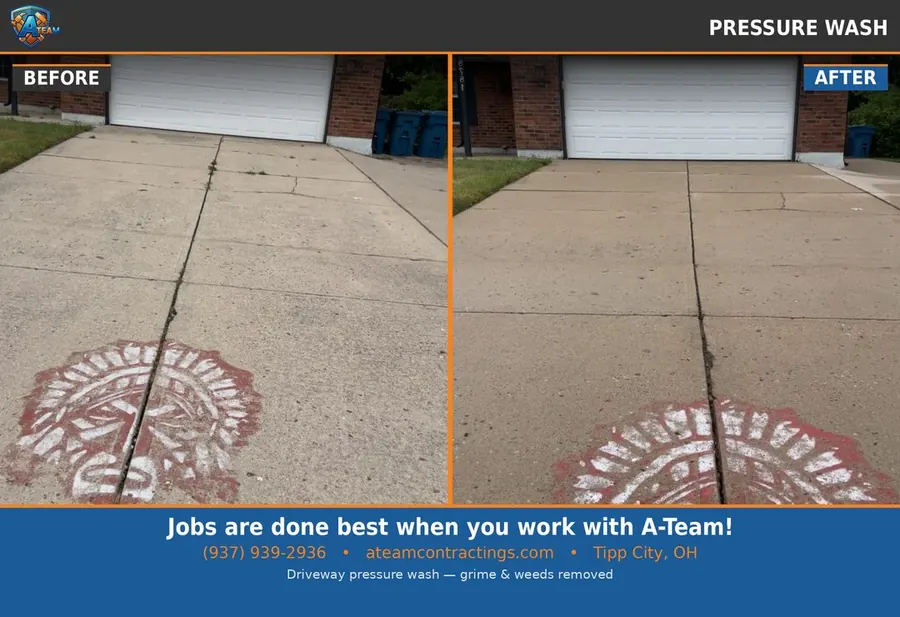
| Concrete driveway, sidewalk, patio | Pressure wash | Hard and porous — takes the force, and a surface cleaner gives an even finish. |
| Brick or stone pavers | Pressure wash (moderate) | Fine at moderate pressure; too much blows the joint sand out. |
| Vinyl siding | Soft wash | Force drives water up under the laps into the wall cavity, where it can't dry. |
| Aluminum siding | Soft wash | Old aluminum has chalked; pressure grinds the oxidation into permanent streaks. |
| Brick and mortar walls | Soft wash | Aged mortar joints erode under pressure and let water behind the wall. |
| Painted wood siding | Soft wash | Pressure strips the paint film — and pre-1978 paint may be lead-based. |
| Stucco and EIFS | Soft wash | Pressure cracks the finish coat and water gets into the system behind it. |
| Asphalt shingle roof | Soft wash only | Pressure strips the UV-protective granules and shortens roof life dramatically. |
| Wood deck | Low pressure + detergent | High pressure raises the grain and furs the boards; ruins a stain job. |
| Composite decking | Soft wash | Force can gouge the cap layer and void some manufacturer warranties. |
| Wood or vinyl fence | Low pressure | Same as decking — clean the mildew out of the grain without shredding it. |
| Gutters (exterior face) | Soft wash | Tiger striping is a bonded oxide film. Detergent lifts it; pressure dents the trough. |
| Window glass and screens | Soft wash / hand | Pressure blows seals and tears screen mesh. |
Why "it came back in a month" happens
This is the single most common complaint we hear about a previous contractor, and it has one cause. Green algae and the black staining on roofs (Gloeocapsa magma) are living organisms with structures that reach into the pores of the surface they're growing on. High-pressure water removes the visible layer on top. It does not remove what's below, and what's below regrows — fast, in an Ohio summer.
Soft washing applies a solution that kills the organism outright and gives it time to work before rinsing. It looks less dramatic while it's happening. It's the reason a soft-washed house stays clean through a season instead of greening up by August.
How to vet a contractor in two questions
1. "What PSI will you put on my siding?" — anything over about 500 is the wrong answer. 2. "Do you use a detergent, or just water?" — "just water, we turn the pressure up" means the algae will be back before fall. Two questions, thirty seconds, and you'll know.
What we do
We run both, and we switch methods as we move around a property — surface cleaner on the driveway, soft wash on the siding above it, hand work on the glass. That isn't unusual for a job; it's most jobs. If you want the detail on either method, we've written both up: soft washing and pressure washing. And if you just want a number, the instant estimator takes about a minute.
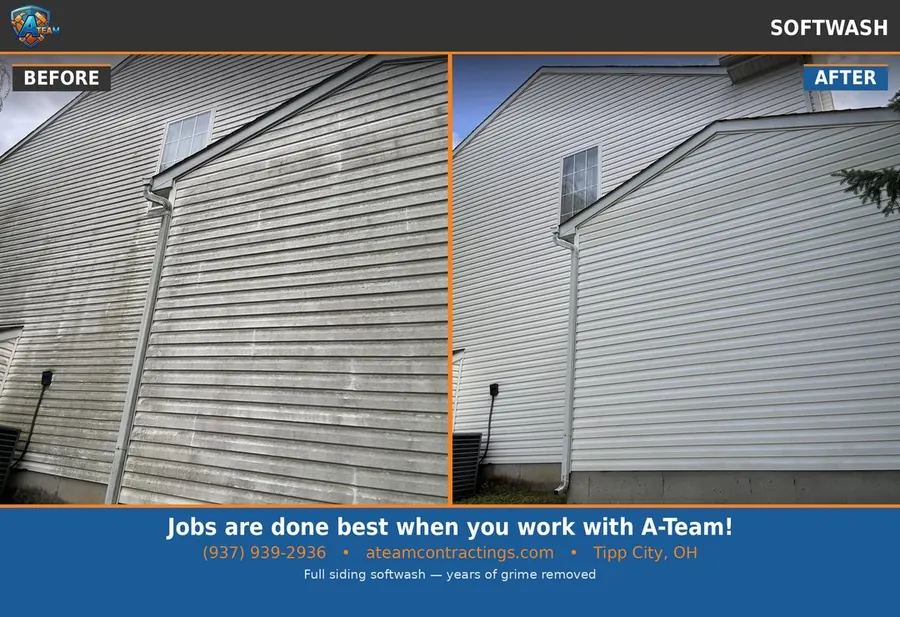
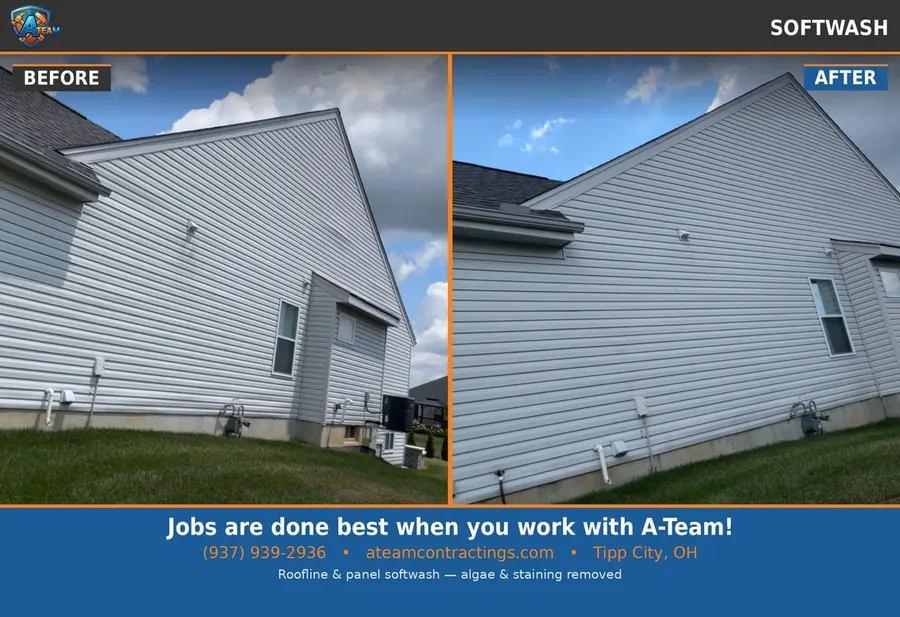
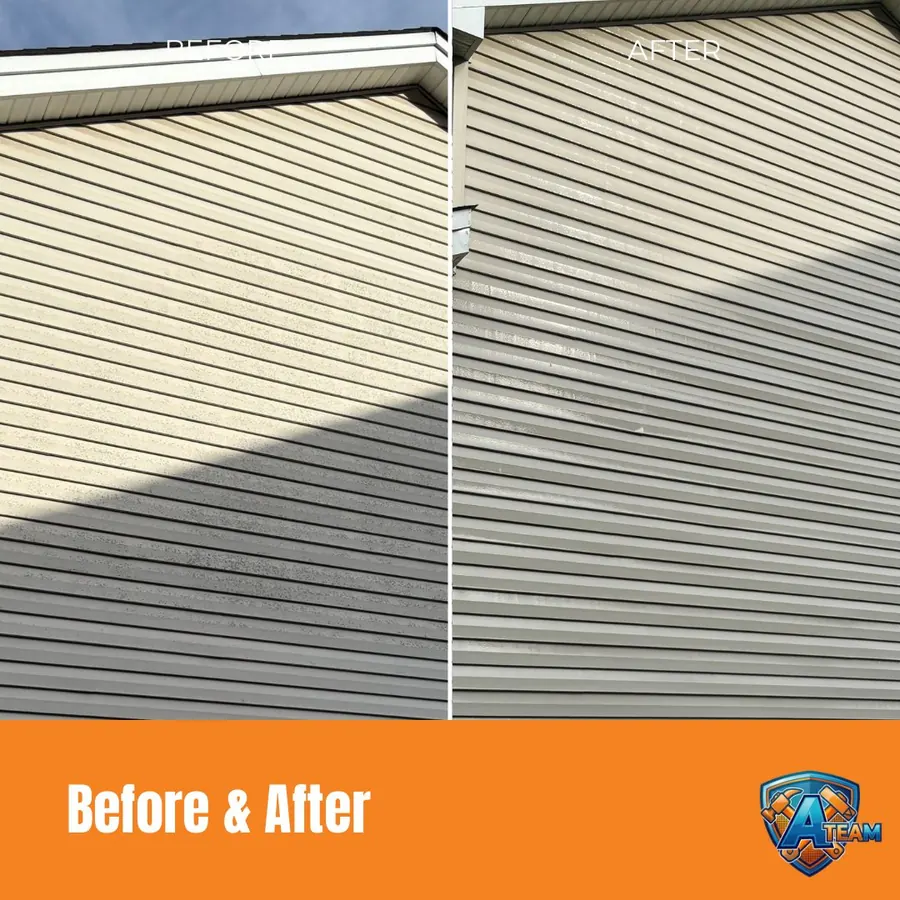
Soft Wash Results
Siding and roofs cleaned with chemistry instead of force.
Soft Washing vs. Pressure Washing FAQ
What people ask us once they realize these are two different things.
Not Sure Which One Your House Needs?
Send us a photo. We'll tell you which method it takes and what it costs — in about a minute.
📸 Get My Instant Price → or call (937) 777-9093